Every March, millions of people try to outguess chaos by filling out NCAA Tournament brackets. Some ride with their alma mater. Others lean on vibes, mascots, or that one Cinderella team everyone saw on TikTok.
This year, I tried something else:
I teamed up with AI to simulate the entire tournament, round by round.
Let’s address the elephant in the room:
• Yes, this was a 70-person pool
• Yes, there was a prize
• No, this wasn’t cheating — it was structured logic + publicly available information
This was less about “gaming the system” and more about using the best available tools to make decisions rooted in data instead of emotion. And if that s not relevant to how we run businesses, I don t know what is.
Step 1: Simulate the Bracket (Three Times)
Once the NCAA bracket dropped, I prompted an AI assistant to:
- Analyze every first-round matchup, using:
- KenPom efficiency rankings
- Offense/defense matchup data
- Player injuries and recent performance
- Simulate each subsequent round using only the winning teams from the prior analysis
- Re-run the analysis three times per round to ensure internal logic was consistent
- Adjust for contrarian vs. consensus picks, especially in later rounds
The result: a bracket built almost entirely on reason, not allegiance.
One key choice that paid off; Ai trusted #1 seeds deeper into the bracket than most people. While most of the field tried to pick the next FAU or this years Saint Peter’s, the AI model said: follow the leaders.
Turns out, 2025 was only the second year in NCAA history (after 2008) where all four Final Four teams were No. 1 seeds.
Step 2: Model the Odds of Winning
Midway through the tournament, I asked the AI to simulate my odds of winning assuming I needed to win 3 more games, each with a 50/50 shot:
- 0.5 × 0.5 × 0.5 = 12.5% chance
Then I asked it to model the odds of winning the whole 70-person pool:
- ~1.43% base probability to win outright if all brackets were equally random
- ~7.14% chance to finish in the top 5
- But, based on bracket structure (ESPN-style 1-2-4-8-12-16 point system), getting late rounds correct matters far more than early perfection
If you correctly pick the Final Four and champion especially when others don’t your probability of finishing near the top spikes.
Step 3: Evaluate AI s Performance (and It’s Blind Spots)
Here’s where it got interesting: when I asked AI to evaluate its own predictions vs actual results, it struggled. Despite making structured, round-by-round picks, it couldn t easily trace its logic backward or summarize what it got right vs wrong without manual prompting.
Takeaway: AI still struggles with memory continuity and multi-step evaluation.
For me, this was less a failure and more of an opportunity for better prompt design, such as:
- Embedding memory anchors in each round
- Logging predictions in an external file for recursive evaluation
- Forcing traceability (think: decision audit trail)
It’s a lesson we can apply far beyond basketball in forecasting, strategy planning, and decision trees.
The Final Scorecard
Here’s how the AI-built bracket performed under standard scoring rules:
| Round | Max Points | Points Scored |
|---|---|---|
| First Round | 32 | 25 |
| Second Round | 32 | 24 |
| Sweet 16 | 32 | 32 |
| Elite Eight | 32 | 32 |
| Final Four | 24 | 24 |
| Championship | 16 | 16 |
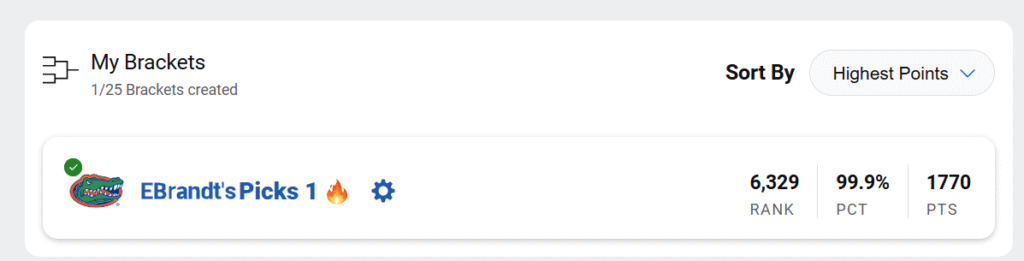
 113 out of 152 possible points before the title game — and a top 1% national finish on ESPN.